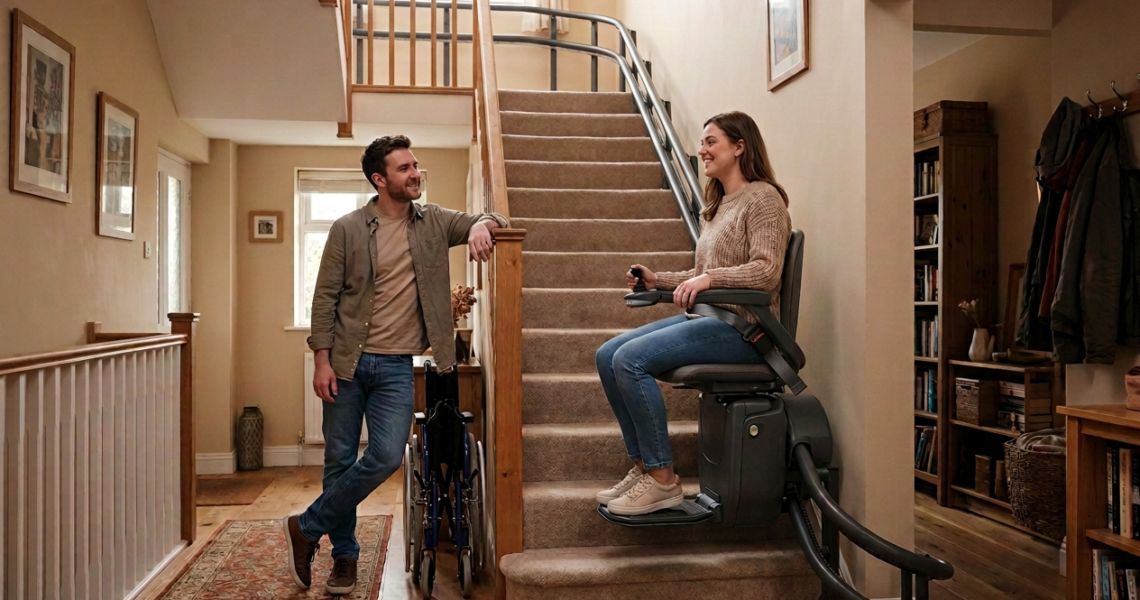
Stair Lifts for the Disabled: An Educational Guide to Choosing the Right One
November 2, 2026Stairs can pose a problem for anyone who has a disability or mobility issue. When reaching another floor becomes difficult, the installation of stair lifts for disabled individuals can make it possible for the home to be more accessible without requiring major structural changes. According to the Administration for Community Living, modifications to your home can help create a safer, more accessible environment as well as allow a person to maintain independence. Home modifications can also help make it easier for a person with disabilities and their caregiver to perform their daily activities.
Choosing the right stair lift means more than just finding a lift that fits the stairway. A person’s mobility needs, the layout of their house, safety issues, and long-term needs should all be considered.
What Types of Stair Lifts Are Available?
According to the U.S. Food and Drug Administration (FDA), a powered stairway chair lift is a motorized device with a permanent fixed location for the purpose of transporting a person with limited mobility up or down a stairway. This provides an alternative means of moving between levels for a person who is unable to climb stairs due to physical disability, injury, chronic illness, or other mobility restriction.
A straight disabled stair chair is appropriate for any staircase that has no bends or turns between levels. A curved stair chair is appropriate for multilevel staircases as it typically requires a rail configured to follow the staircase.
Location is important. When searching for a mobility lift for disabled individuals, it is important to consider whether the equipment will be used indoors or outdoors. Indoor accessibility lifts are made for inside use only, while outdoor stair lifts must be able to withstand exposure to changing weather.
What Should You Consider When Choosing a Stair Lift?
The staircase is only half of the equation. The lift also has to work for the person who will use it. According to the U.S. Department of Veterans Affairs, applications of assistive technologies are determined by the person’s requirements and abilities, as well as the tasks they need to perform and the context of technology usage.
When assessing stair lifts for disabled individuals, consider the following points:
- The ability to sit and rise
- Degree of balance and stability
- Ability to manage controls
- Correct seat and weight capacity
- Width and shape of the staircase
- Space available at the top and bottom of the stairs
- Whether caregiver assistance is typically needed
Homeowners searching for a home stair lift disabled individuals will find suitable should look at these factors rather than simply choosing based on price appearance.
Which Stair Lift Safety Features Matter?
Safety should always be a priority when comparing stair lifts for disabled individuals. The features can vary by model, but a common set of points includes seat belts, obstruction sensors, swivel seats, footrests, armrests, or battery-powered operation.
The swivel seat allows users to easily turn their bodies away from the stairs and face toward the landing, helping users exit the disabled stair chair easily. The obstruction sensors will stop the lift if an object is detected in its path. Battery operation can also allow compatible models to remain usable during a power outage.
How Can a Professional Help You Find the Right Fit?
For someone who has difficulty climbing stairs because of a physical disability, injury, chronic condition, or another mobility limitation, accessibility lifts can provide an alternative way to move between levels. With different stair configurations, mobility needs, and product features to consider, choosing the right stair lift does not have to be a decision made alone. Professionals at EZ Living Concepts can help determine which mobility lift for disabled individuals best accommodates the user’s needs, available space, and staircase configuration.
If you’re ready to explore stair lifts for disabled individuals customized around your home and mobility requirements, contact us today at (610)-583-9000 or sales@ezlivingconcepts.com to schedule an in-home consultation. Let’s take the next step toward making every level of your home safe and accessible.