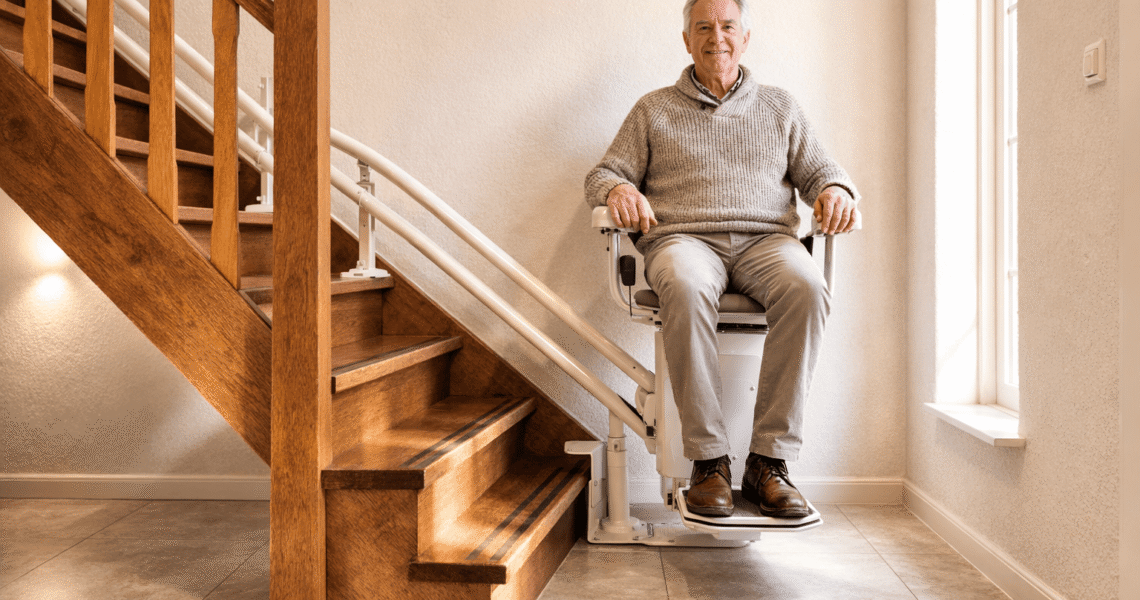
Straight vs. Curved Stair Lifts: Which One Should You Choose?
March 2, 2026Stairs are often the first place in the home where mobility challenges become noticeable. What was once routine can gradually feel unsafe or physically demanding. For many homeowners researching solutions, the key question becomes whether a straight stair lift will meet their needs or whether a curved system is required. The answer depends on three primary factors: your staircase design, your long-term mobility goals, and your budget. Understanding how these systems differ- and how stair safety impacts aging adults- can help you make a confident and informed decision.
Understanding the Difference Between Straight and Curved Stair Lifts
A straight rail stair lift is designed for staircases that travel in one continuous, uninterrupted line. There are no turns, curves, or intermediate landings. Because of this simplicity, it uses a pre-manufactured rail rather than a custom-fabricated one. Often referred to as a standard stair lift, this model mounts directly to the stair treads and is typically installed in just a few hours. Since the rail does not need custom engineering, costs are generally lower compared to curved systems.
For homeowners with a single, straight staircase, this is usually the most practical and economical solution. The streamlined design provides reliable mobility support without the added expense of customization. A curved stair lift is specifically engineered for staircases that include turns, 90° or 180° angles, intermediate landings, or spiral sections. Unlike a basic stair lift, which follows a straight path, a curved model requires detailed measurements so the rail can be custom-built to match the exact structure of your stairs.
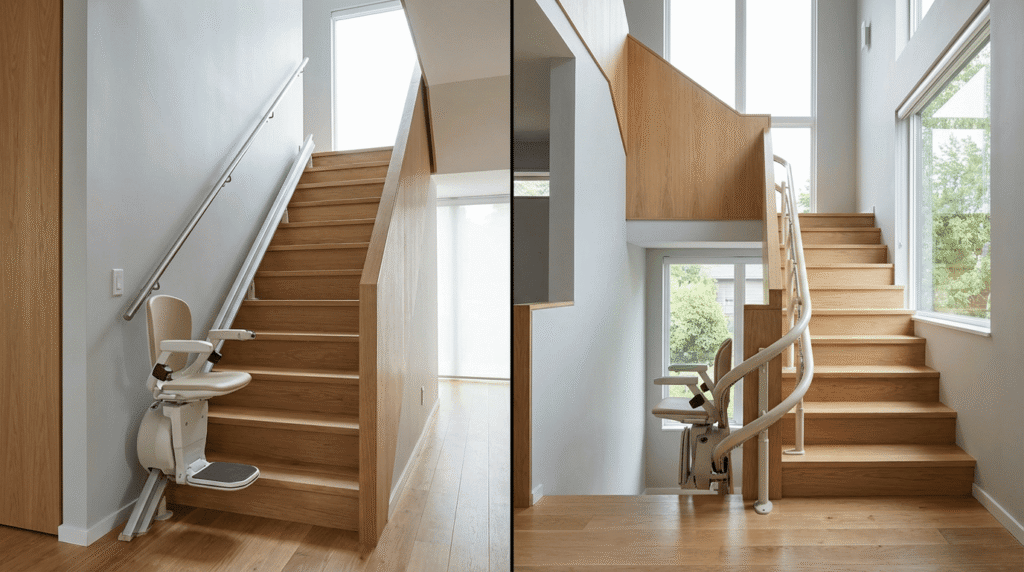
In a curved vs straight stair lift comparison, the primary difference comes down to customization versus simplicity. Curved systems require longer fabrication times and a higher investment, but they allow seamless travel across complex stair layouts that a straight system cannot accommodate.
How Staircase Design Determines Your Options
The architecture of your staircase determines which type of lift is compatible. Important structural factors include:
- Presence of directional turns
- Multiple landings
- Staircase width and clearance
- Spiral or split-level construction
- Available space at top and bottom landings
According to accessibility guidance from the U.S. Access Board, proper clearance and professional installation are essential to ensure safety and compliance. A qualified assessment ensures the lift does not obstruct stair use for others in the household and operates safely within the home’s layout.
Why Staircases Become a Health Risk as We Age
Choosing the appropriate lift is not simply about convenience. It is about preventing injury and maintaining independence.
Falls Among Adults 65 and Older: The Centers for Disease Control and Prevention (CDC) reports that one in four adults aged 65 and older falls each year. Falls are the leading cause of injury-related deaths in this age group. Staircases significantly increase the severity of falls due to both height and force of impact. Even a single fall can dramatically change a person’s mobility and independence.
Recovery Complications from Stair Injuries: Hip fractures and other serious injuries often require surgery and lengthy rehabilitation. According to the National Council on Aging, many older adults never fully regain their previous level of independence after a major fall. Stair-related injuries frequently result in long-term mobility decline, increased reliance on caregivers, or transition into assisted living environments. Prevention is often far less costly- financially and physically- than recovery.
The Psychological Impact of Fear of Falling: Physical injuries are only part of the risk. Research available through NIH databases shows that fear of falling can significantly reduce physical activity, even in individuals who have never experienced a fall. When older adults avoid stairs due to fear, muscle strength and balance may decline. Reduced movement can lead to isolation, decreased confidence, and a cycle that actually increases fall risk. Installing the correct lift can help restore confidence and provide safe access to every level of the home, breaking that cycle before it escalates.

Which Stair Lift Is Right for Your Situation?
When comparing your options, staircase configuration remains the most important factor.
Best for Budget-Conscious Buyers
If your home has a single, uninterrupted flight of stairs, a straight stair lift is typically the most affordable option. Because it uses a pre-manufactured rail, installation is faster and does not require custom engineering. For many households, this solution provides dependable mobility support without exceeding budget constraints.
Best for Complex Staircases
Homes with landings, turns, or multi-level designs require custom engineering. In a curved vs straight stair lift evaluation, curved systems offer precise rail fabrication that follows the exact path of the staircase. While the investment is higher, the customization ensures safe and seamless travel throughout more intricate layouts.
Best for Aging in Place
Aging in place involves planning for both current and future mobility needs. Some homeowners begin with a standard stair lift but later require additional modifications as mobility changes. Evaluating long-term needs from the start can prevent future upgrades or costly replacements. A professional consultation can help determine whether a straight or curved configuration will best support long-term independence.
Key Differences at a Glance
To summarize:
- A straight rail stair lift works best for simple, uninterrupted staircases.
- A basic stair lift typically refers to a straight configuration without customization.
- In a curved vs straight stair lift comparison, curved systems are custom-built for turns and landings.
- Straight models are generally more affordable and faster to install.
- Curved models accommodate complex architectural designs.
Both systems significantly reduce fall risk and help preserve independence.
Final Thoughts
Selecting the right lift begins with evaluating your staircase layout. A straight stair lift is ideal for homes with simple stair designs and offers a practical, cost-effective solution. Curved systems provide necessary customization for more complex staircases.
The ultimate goal is to restore safe, reliable access between floors while reducing fall risk and supporting long-term independence. By considering structure, safety, and future mobility needs, homeowners can confidently choose the solution that best fits their lifestyle. At EZ Living Concepts, we specialize in providing reliable, professionally installed stair lifts tailored to your home and mobility needs. Contact us today at (610)-583-9000 or sales@ezlivingconcepts.com for your free consultation.